Amid drone strikes and blackouts, Jewish holidays and celebrations remain unchanged
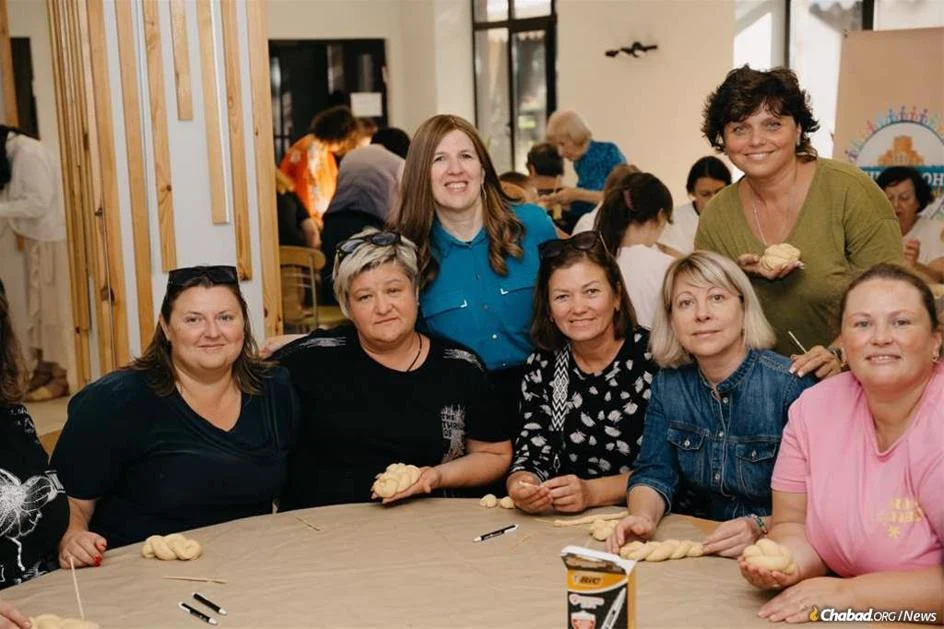
By Faygie Levy Holt | Chabad.org | Photo: Miriam Moskovitz leads a challah bake during pre-Rosh Hashanah Shabbaton for her Kharkiv community.
Just two weeks before the start of Rosh Hashanah, a drone exploded near Chabad-Lubavitch of Kyiv, Ukraine—a reminder, as if anyone needed one, that for the fifth time, the Jewish New Year would once again be celebrated under crisis conditions.
“When the drone landed, it became clear that we simply could not take the risk of gathering hundreds of people in one place,” said Rabbi Yonatan Binyamin Markovitch, the center’s director and chief rabbi of Kyiv. “We made the decision not to cancel Rosh Hashanah services, but to change the way we celebrated it. We divided the main gathering into several smaller events, and the holiday prayers were also held in smaller groups, as close as possible to protected shelters.”
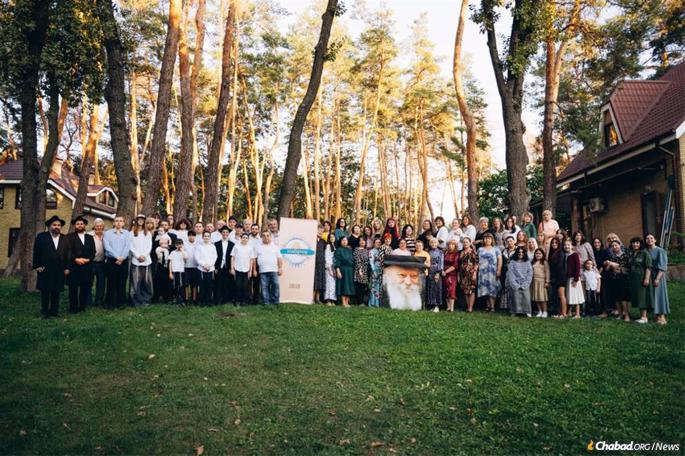
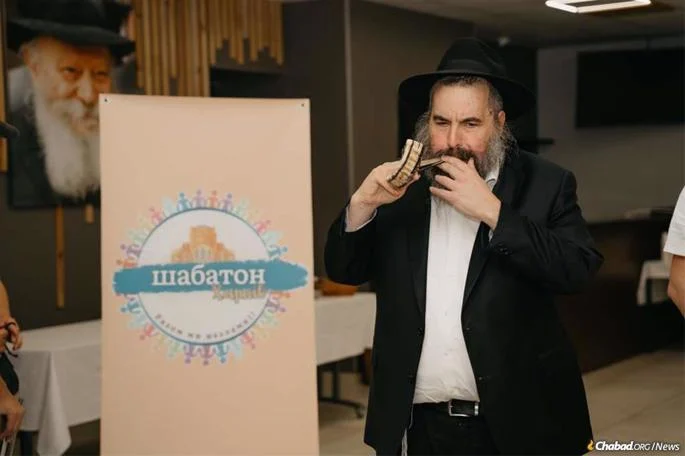
Ahead of the holiday, Rabbi Moshe and Miriam Moskovitz, who direct Chabad of Kharkiv, hosted a Shabbaton for local families, drawing about 100 participants to a relatively quiet area two-and-a-half hours from the front line city, giving everyone a chance to unwind and enjoy a peaceful Shabbat together. “The theme was, together we are unbreakable,” Mrs. Moskovitz said. “It was a very special bonding experience.”
“People are tired. They want to have hope things will be over soon, but it’s a long time to be at crisis. In a very sad way, you get used to being in a harsh zone,” she added. “Thank G‑d, Rosh Hashanah was pretty quiet.”
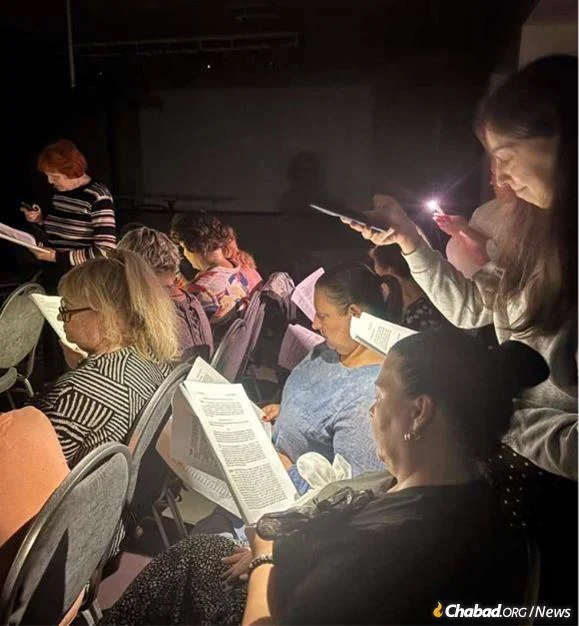
Because the holiday fell on a weekend, more people than usual came to the Choral Synagogue in the Kharkiv city center, with more than 600 in attendance. Afterward, the group continued on to a local lake to recite the tashlich prayer, stopping at the site of a former synagogue where, during the Holocaust, 400 men, women and children were locked inside and killed by the Nazis. The Jewish community recited a chapter of Psalms together in their memory.
Among those who came to pray was a community member named Avital.
“I’m not sure why, but something about the shofar blowing makes me so emotional. When I heard the shofar, I had tears in my eyes,” she said. “In a city that has heard so many frightening sounds over these years, hearing the shofar was completely different. It was a sound of faith, of hope and of Jewish life no matter what.”
Another community member, Alexander, said that saying “L’shanah tovah” felt different this year. “It wasn’t just a greeting. We were really praying for a year of peace, safety and revealed goodness—for ourselves, for Kharkiv, for Ukraine and for the entire Jewish people.”
“In general, the whole situation in Ukraine has become more difficult,” Moskovitz adds. “It’s not just the front-line cities like Kharkiv getting attacked. Because of the drones and the reach of rockets, there are also attacks in Kyiv, Odessa, and other cities.”
The crisis has been particularly difficult on the elderly members of her Kharkiv community.
“We have a special program in the synagogue to help people, not only with medicine but guidance on which doctors to go to,” she says. “We have become their extended family. Just a few days ago, we found out a very old lady in the community was in terrible medical condition and her living conditions were also terrible. We worked to get her into a hospital so that she could be treated.”
Rabbi Markovich describes the effects of crisis on Kyiv.
“The city continues to come under attack almost daily. Food and medicine warehouses, as well as fuel stations, have been among the sites targeted, adding to the anxiety and uncertainty people are already experiencing,” he says. “Many residents are stocking up on food and essential supplies, and on many nights, families sleep in underground metro stations, which for many people are the safest available shelters during attacks.”
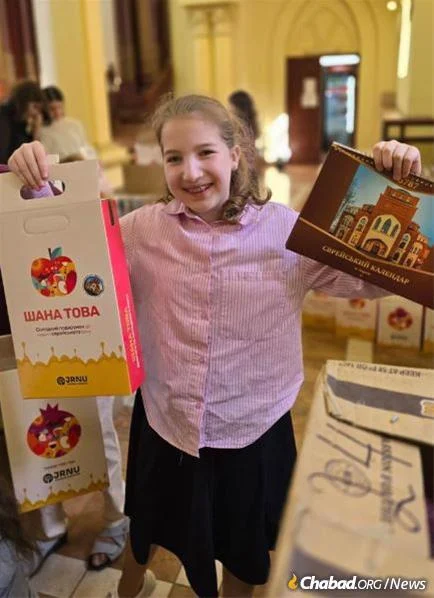
To meet the need, the Jewish Relief Network Ukraine—Chabad’s boots-on-the-ground aid network across the country—prepared 35,000 food care parcels, the largest food giveaway the organization has undertaken. In Kyiv, 500 food packages were distributed before the holiday, and 620 hot meals were provided to elderly people living alone during Rosh Hashanah. In Kharkiv, Chabad distributed 1,000 food packages, along with holiday packages that included apples and honey, candles for the month’s holidays, and candle-lighting times.
“In the reality of crisis, fear and uncertainty, people need more than physical assistance. They need faith, a sense of belonging, and the knowledge that they are not alone, Rabbi Markovich said. “The fact that the sound of the shofar was heard again this year in Kyiv, despite everything happening around us, carries a powerful message: Jewish life in Kyiv and throughout Ukraine continues.”
And so, too, do Jewish lifecycle events continue.
In Kharkiv, Jewish women gathered this week to celebrate the bat mitzvah of the Moskovitzes’ youngest daughter, Malka—the second such celebration the community has marked during the crisis, following the bar mitzvah of the Moskovitzes’ son, Yisroel, during Sukkot three years ago.
“Malka was born here in Kharkov; the women have literally watched her grow up,” Moskovitz said. “She’s very positive and always smiling, and I think it’s very important for people to see we are here with them, even in crisis, and we are here to celebrate our simchas with them.”